By Jason Engelhardt
Defense tech is no longer a niche. It’s becoming the center of gravity for the next wave of venture investment.
For years, venture capital largely avoided the sector.Too slow. Too regulated. Too dependent on government procurement cycles.
That perception wasn’t wrong—it was just tied to a different era.
Today, three forces are reshaping that reality:
1. Geopolitics is back.Global competition is no longer theoretical. It’s influencing supply chains, capital flows, and national priorities in real time.
2. Technology has gone dual-use by default.AI, autonomy, drones, cyber, and advanced manufacturing—these are no longer purely commercial categories.
They sit at the intersection of enterprise value and national security.
3. Governments are changing roles.
They’re no longer just regulators.They are becoming:
-
Early customers
-
Co-investors
-
Accelerators of adoption
And in some cases, the only buyer that matters.
This is driving a fundamental shift in how capital thinks.
We’re moving from:“What can scale quickly?”
To:“What must scale—because it matters?”
That’s a very different filter.
Investors are starting to prioritize:
-
Resilience over efficiency
-
Strategic importance over short-term returns
-
Long-term alignment over rapid exits
Because in this environment, some technologies are simply too important to fail.
But here’s where most conversations still fall short:
Defense tech isn’t just a capital problem. And it’s not just a technology problem.
It’s an execution environment problem.
The real constraint isn’t ideas.It’s the ability to:
-
Test in real-world conditions
-
Operate in controlled airspace
-
Integrate with military and federal stakeholders
-
Navigate regulatory pathways without losing momentum
That’s what separates prototypes from deployment.
And it’s why so many promising companies stall—not because the tech doesn’t work, but because the environment to scale it doesn’t exist.
This is where the next wave of opportunity is forming.
Not just in startups—but in ecosystems that can support them.
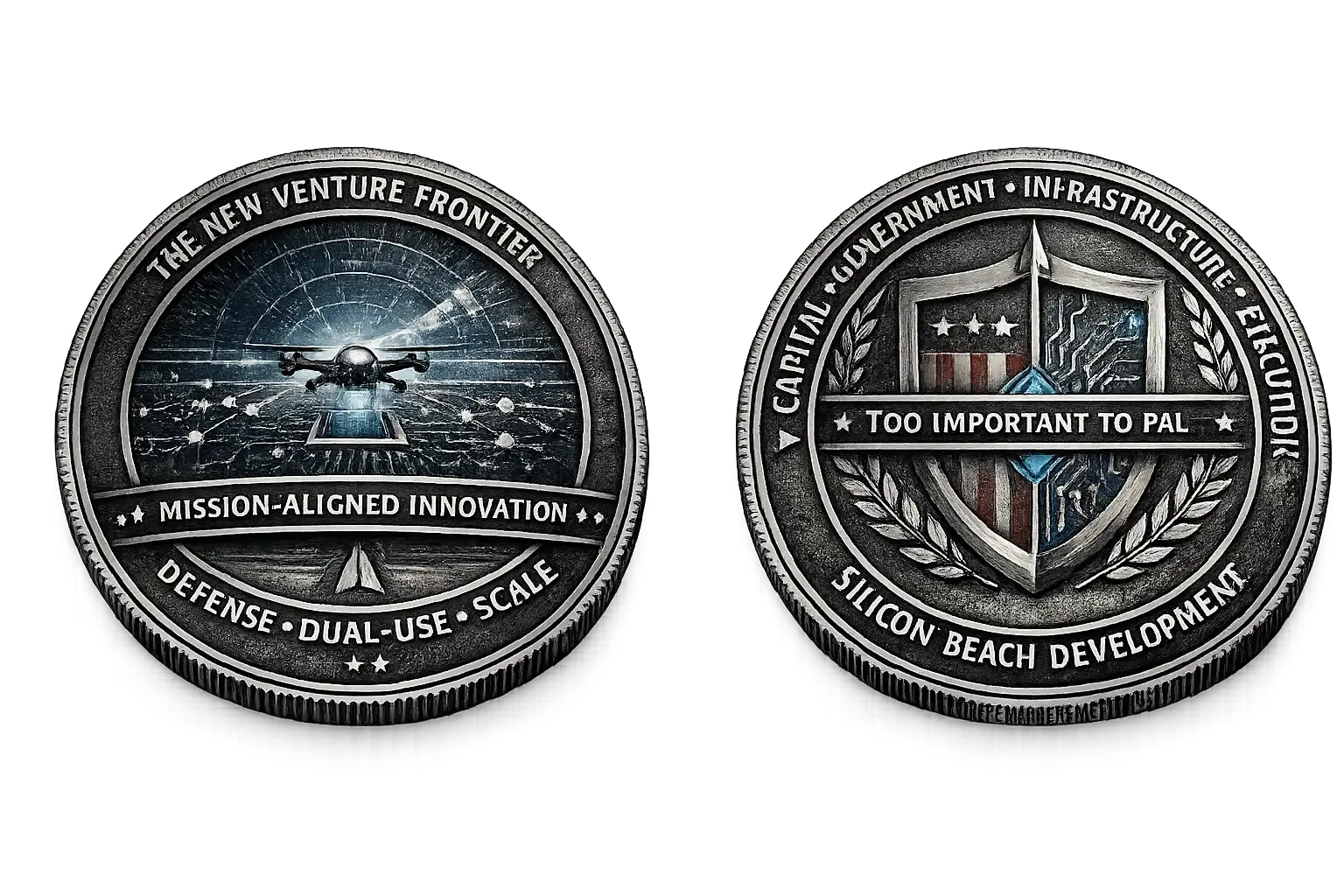
Places that can align:
-
Capital
-
Government
-
Infrastructure
-
Operators
Into a single, coordinated system.
Because in this next phase, innovation doesn’t win in isolation.It wins in alignment.
That’s the shift behind what we’re seeing—and what we’re actively working toward with Silicon Beach Development:
Not just investing in or supporting companies, but helping build an environment where defense and dual-use innovation can actually move from concept to capability.
The venture landscape is changing.
And the smartest players aren’t just asking:“What should we build?”
They’re asking:“Where can it actually be built—and who needs to be aligned to make it real?”